The giant lizard creature
Holding Out for a Hero ▸ Stiles Stilinski (2)The giant lizard creature is an apparently homicidal reptilian being whose intrusion into Carson Bradley’s home transforms an isolated fright into a wider threat to Beacon Hills civilians. It is significant not only because it can attack ordinary people, but because it resists familiar explanations: it looks like an overgrown lizard, behaves with apparent intelligence, survives a direct blow to the head, and leaves behind no clear history or online record. The creature therefore functions as both a physical menace and an unanswered question at the center of the supernatural investigation.
Appearance and First Encounter
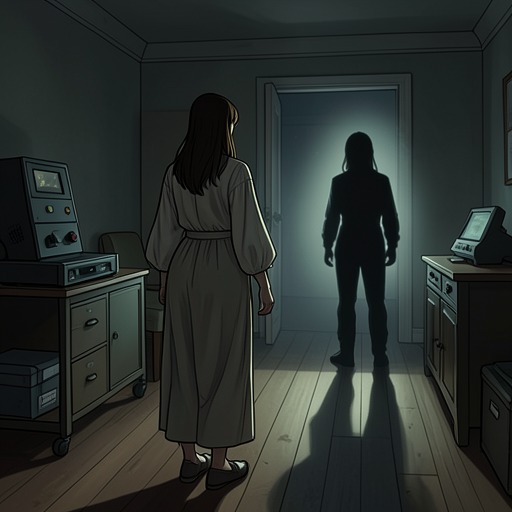
The creature first appears in the darkness of the hallway at Carson Bradley’s home. Before its body becomes fully visible, two reptilian eyes gleam from the shadows, producing a moment of fear built on partial recognition rather than complete knowledge. Its approach turns that uncertainty into an immediate physical threat: screaming does not drive it away, and the creature instead lurches forward until its scaly body enters Carson Bradley’s view.
Its visible form is distinctly monstrous. It is described as an overgrown lizard, probably taller than Carson Bradley, with a long tail, gleaming eyes, and rows of teeth that look sharp enough to function as weapons. The scale and posture of the creature place it beyond the category of a normal animal, while its teeth and forward charge suggest deliberate violence rather than accidental intrusion. The hallway, the darkness, and the creature’s gradual emergence create a tightly enclosed horror scene in which the house no longer provides safety.
Attack and Unnatural Mobility
Carson Bradley responds with the means immediately available: a metal bat. After urging the creature forward, Carson Bradley swings with both hands when it is less than two feet away. The bat connects solidly with the creature’s head, producing a sickening crack, but the impact causes no apparent injury. Instead of retreating in pain, the creature stops and cocks its head, watching Carson Bradley as though it knows who is standing before it.
That reaction gives the creature a disturbing intelligence. It does not behave like a mindless attacker that simply continues until defeated. It appears to assess Carson Bradley, and then it chooses to leave. Within seconds, it scuttles up the wall, crosses onto the ceiling, passes through the room, and slips out of the window. The escape violates ordinary expectations of animal movement and makes the building itself part of the creature’s range. Carson Bradley is left staring at the billowing curtains with the bat hanging uselessly at her side, unable to determine what has entered her home or why it has withdrawn.
From Private Fright to Public Threat
The incident becomes part of a larger emergency when Carson Bradley later meets with Allison Argent, Scott McCall, and Stiles Stilinski. Scott McCall characterizes the seriousness of their problem through a comparison to Godzilla, and Carson Bradley recognizes that the creature being discussed is the same giant lizard that entered her house. Her report supplies the group with a concrete account of its behavior: screaming failed to frighten it, the creature charged, a bat struck it, and it then ran across the ceiling before leaving.
The disclosure changes the status of the encounter. What might have been dismissed as a frightening misperception or a single break-in is treated as evidence of another threat operating in Beacon Hills. The group concludes that the giant lizard may endanger civilians, placing the creature alongside the supernatural dangers already occupying their attention. Its ability to enter a private home also removes the boundary between ordinary daily life and the hidden world the characters are trying to contain.
Investigation and the Problem of Naming
The investigation produces little certainty. Searches for Kanima, Kanima legends, shape-shifting Kanima, and a giant lizard that cannot swim yield almost nothing: no useful sightings, stories, or legends appear online. Derek Hale has heard stories, but those accounts are not available through the internet, and the bestiary open on Stiles Stilinski’s laptop contains unfamiliar words that Carson Bradley cannot understand. Even an online translator is considered unreliable for the task.
The lack of searchable evidence is important because it prevents the creature from becoming manageable through simple classification. The investigators know that it is connected to the Kanima problem, and they suspect that it is a shape-shifter afraid of itself because it does not know its own identity, but the available material does not explain the creature they have actually encountered. Carson Bradley finds a page about a were-jaguar and considers whether it might offer a starting point, yet the information has no direct relevance to the lizard. The search thus widens the field of possibility without resolving the central mystery.
Narrative Function and Significance
The creature’s design combines horror with investigative uncertainty. Its first appearance moves from unseen eyes to a fully displayed body, but visibility does not produce comprehension: even after Carson Bradley sees its height, tail, teeth, and scales, the creature remains unidentified. The failed bat attack intensifies that effect, since a concrete act of resistance produces no reassuring consequence. The creature can be seen, struck, and watched as it escapes, yet it still cannot be understood.
Its repeated association with the Kanima investigation also makes it a displaced image of the story’s larger concern with unstable identity. The investigators search for a name that would tell them what the creature is, while the available clues suggest a shape-shifter that does not know itself. The creature’s apparent self-recognition, expressed through the way it watches Carson Bradley, contrasts with the humans’ inability to recognize it. That tension gives the monster a double role: it is an immediate predator and a symbol of knowledge withheld until the supernatural threat can be placed within a larger system of rules.
The giant lizard creature therefore matters less as a solved species than as an escalation. It crosses walls, ceilings, windows, and the limits of the characters’ existing knowledge, converting the domestic interior into a vulnerable threshold. By surviving Carson Bradley’s attack and remaining absent from ordinary records, it leaves the group with the most dangerous kind of evidence: enough physical reality to demand action, but too little explanation to make that action secure.